Fulham Electrical Advice
Is a Power Outage Always an Electrical Fault in Fulham?
A sudden loss of power can feel like an emergency, especially in a busy Fulham home, shop, office or rental property. However, a power outage is not always caused by a fault inside your electrical installation. Sometimes it is a wider network issue, sometimes it is a tripped protective device, and sometimes it is a warning sign that you need a qualified Electrician in Fulham to test the circuit safely.
The key is knowing the difference between a local power cut and an internal electrical fault. Resetting switches repeatedly without understanding the cause can hide a more serious issue, while calling an electrician for a network-wide outage may not solve the problem. This guide explains what to check, when to call 105, and when professional electrical fault finding is the safer option.
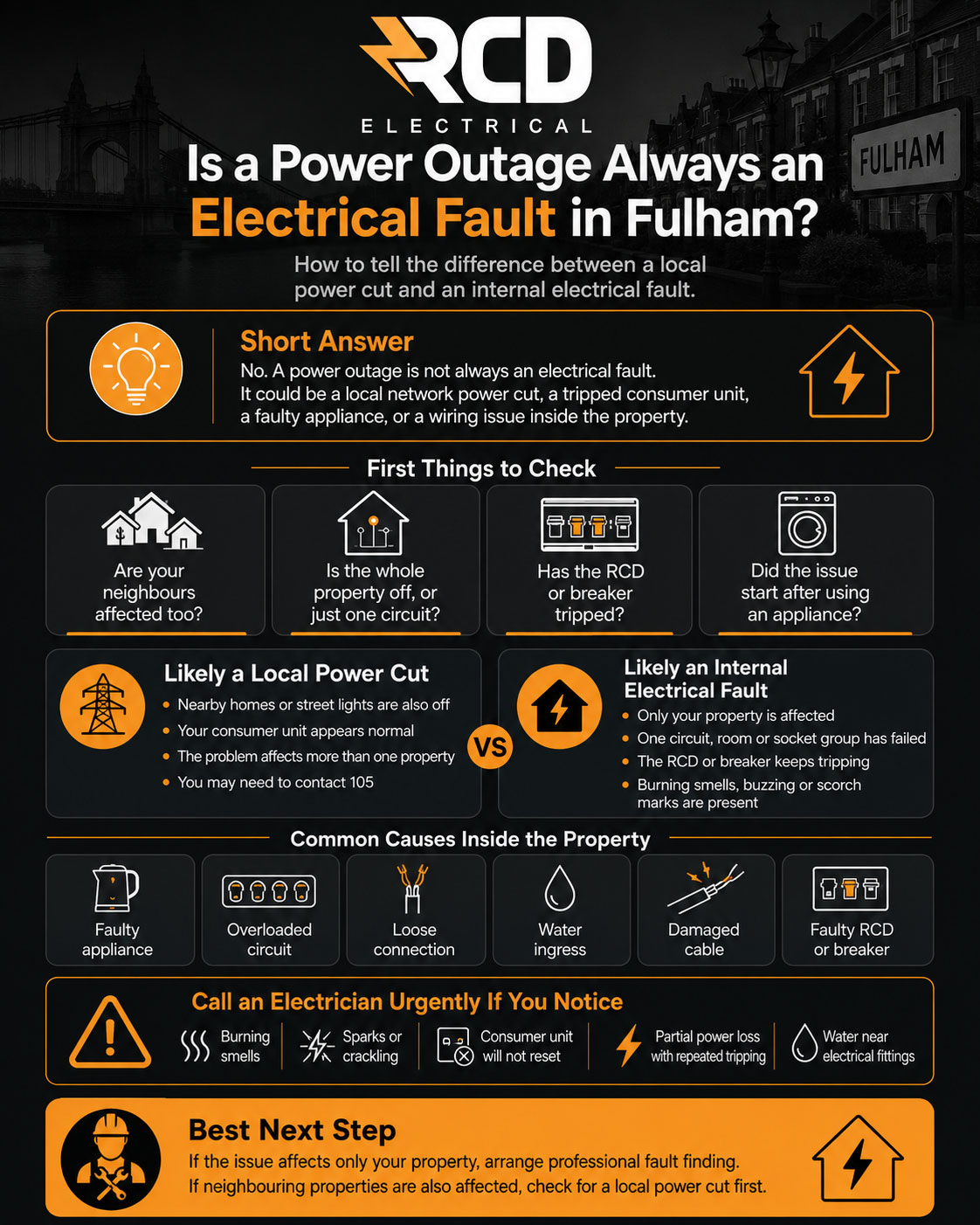
Click the infographic to enlarge it.
Power Outage or Electrical Fault?
The phrase “power outage” is often used for any sudden loss of electricity, but the cause can vary. In Fulham, a property may lose power because of a wider electricity network issue, a damaged service cable, a supplier or meter problem, a tripped consumer unit, an overloaded circuit, a faulty appliance or hidden wiring damage.
A true network power cut normally affects more than one property. You may notice neighbours without electricity, street lighting affected, or local businesses experiencing the same issue. In that case, your local electricity network operator is responsible for investigating the supply side.
An internal electrical fault is different. This is usually limited to your property, one floor, one room, one circuit or a particular appliance. If only your kitchen sockets are off, your lights work but your sockets do not, or the RCD trips whenever you reset it, the problem is more likely to be inside the installation.
Simple rule: if the whole street is affected, check the local network. If only your property or one circuit is affected, treat it as a possible electrical fault.
First Checks Before You Panic
Before assuming the worst, carry out a few safe checks. Look outside and see whether neighbouring properties have lights. Check whether street lights, nearby shops or communal hallway lights are working. If you live in a flat, check whether the issue affects only your unit or the whole building.
Next, look at your consumer unit without touching damaged parts. If one switch is down, one circuit has probably tripped. If the main switch or RCD is off, there may be a fault affecting a larger part of the installation. If all switches are up but you still have no power, the issue may be supply-side, meter-side or related to the main incoming service.
- Are your neighbours also without power?
- Is the entire property off or just one circuit?
- Has an appliance just been switched on?
- Can you smell burning or see scorch marks?
- Has water leaked near electrics?
- Is the consumer unit making a buzzing sound?
These checks help you decide whether to contact the network operator, your electricity supplier, your landlord or a local electrician. They should never involve opening electrical equipment, removing covers or touching exposed cables.
When It Is a Local Network Power Cut
A local network power cut happens outside your property’s internal wiring. It may be caused by damaged underground cables, a fault at a substation, planned engineering work, severe weather, third-party damage or a wider supply interruption. In this situation, an electrician cannot restore the external network supply because the issue belongs to the electricity distribution operator.
In London, customers can check and report power cuts through the local network operator. The national number 105 is also available in England, Scotland and Wales for power cut enquiries. It connects you to the correct electricity network operator for your area.
Signs it may be a network power cut
- Your neighbours also have no electricity
- Street lights or communal supplies are affected
- Your consumer unit appears normal but power is off
- The outage affects several nearby properties
- There is visible damage to external electrical equipment
- The network operator confirms a local fault
If there are fallen cables, damaged street equipment or a dangerous external situation, keep well away and report it immediately. Do not touch cables, metal covers, damaged service heads or exposed equipment.
When the Fault Is Inside Your Property
If the outage only affects your home, office, shop or flat, the cause may be inside the property. This is where professional diagnosis becomes important. A tripped breaker is not the fault itself; it is often a warning that the protective device has detected a problem.
Internal electrical faults can appear suddenly. A socket circuit may fail after an appliance is plugged in. Lights may go off after moisture enters a fitting. An RCD may trip repeatedly because of earth leakage. A consumer unit may refuse to reset because the fault is still present.
This is where Electrical Fault Finding Fulham becomes valuable. A qualified electrician can isolate the affected circuit, test safely, identify the cause and confirm whether the issue is an appliance, cable, accessory, protective device or supply problem.
Important: repeatedly resetting a breaker or RCD without testing can be risky if the cause is overheating, damaged insulation, water ingress or a loose connection.
Common Faults That Cause Power Loss
Not all power loss looks the same. Some faults remove power from the whole property, while others only affect a particular room or circuit. In Fulham properties, electricians often see faults linked to older wiring, extensions, kitchen appliances, outdoor electrics, rental property wear and previous DIY work.
- Faulty appliances tripping the RCD
- Loose socket or switch connections
- Damaged cable insulation
- Water ingress into outside lights or sockets
- Overloaded extension leads or circuits
- Burnt accessories or overheated terminals
- Faulty MCBs, RCBOs or RCDs
- Broken neutral or earth conductors
- Rodent-damaged or mechanically damaged cables
- Poor previous alterations to the wiring
Some of these faults are straightforward to locate. Others require insulation resistance testing, continuity testing, polarity checks, RCD testing and circuit isolation. Guesswork is not enough when the fault is hidden behind walls, under floors or inside accessories.
Why RCDs and Breakers Trip
Your consumer unit is designed to protect the installation. A circuit breaker may trip when there is overload or a short circuit. An RCD or RCBO may trip when it detects leakage current to earth. This can happen because of a faulty appliance, damaged cable, moisture, a wiring defect or equipment failure.
If the RCD trips once and stays on after a clear appliance-related cause is removed, the problem may be minor. If it trips repeatedly, will not reset, or only trips when a particular circuit is energised, the installation needs proper testing.
Typical tripping patterns
- Trips when the kettle, oven or washing machine is used
- Trips after rain when outdoor electrics are wet
- Trips randomly with no obvious trigger
- Trips when lights are switched on
- Trips only at night or during high load
- Trips immediately after reset
These patterns help an electrician narrow down the cause. However, the final diagnosis should come from testing, not assumptions.
Power Outage in Flats and Rental Properties
Fulham has many flats, maisonettes, converted buildings and rental properties. In these buildings, a power outage can be more complicated. The issue may be inside the individual flat, within communal areas, at the meter cupboard, in a landlord-controlled distribution board or with the external network.
Tenants should report electrical problems to the landlord or managing agent, especially when the issue affects fixed wiring, consumer units, sockets, lighting or communal electrical systems. Landlords should take repeated tripping, burning smells, failed sockets and partial power loss seriously because they may point to safety defects.
In commercial and mixed-use buildings, it is also important to confirm which distribution board controls the affected area. Shops, offices and hospitality premises can lose trading time if the diagnosis is delayed or the wrong part of the installation is checked first.
When to Call an Electrician
You should call a qualified electrician when the outage is limited to your property, when a breaker or RCD keeps tripping, when only one area has lost power, or when there are signs of overheating, burning, buzzing or water damage.
You should also call an electrician if the consumer unit will not reset, if power comes and goes, if sockets are dead but lights remain on, or if the fault affects essential equipment such as heating controls, fridges, security systems or business equipment.
For a local diagnostic visit, No Call-Out Charges – Electrical Fault Finding in Fulham can help homeowners, landlords and businesses get the issue tested properly without relying on trial and error.
Call an electrician urgently if you notice burning smells, visible sparks, melted plugs, scorch marks, buzzing from the consumer unit or power loss after water has entered electrical fittings.
Safety Steps During a Power Outage
During a power outage, safety comes first. Use a torch rather than candles where possible. Switch off sensitive appliances if the power is going on and off. Do not open the consumer unit, meter, service head or electrical accessories. If you smell burning, see smoke or hear crackling, keep away from the affected area and get professional help.
If the outage appears to be local and affects neighbouring properties, contact the network operator or call 105. If the problem is only inside your property and involves tripping, burning smells, sockets not working or partial power loss, arrange electrical fault finding.
- Use a torch instead of candles
- Keep fridge and freezer doors closed
- Unplug sensitive electronics if power is unstable
- Do not touch exposed or damaged cables
- Keep children away from the consumer unit
- Call for help if you suspect an internal electrical fault
Professional Fault Finding in Fulham
A power outage is not always an electrical fault, but it should always be approached carefully. The safest response is to identify whether the problem is external, supply-side, appliance-related or part of your fixed wiring. Once that difference is clear, the right action becomes much easier.
Professional electrical fault finding is about more than restoring power quickly. It helps prevent repeated outages, protects appliances, reduces fire risk and gives you confidence that the installation is safe to use.
If your power loss is limited to your home, flat, shop, office or rental property, our experienced Fulham Electricians can test, diagnose and repair the issue with care, helping you restore power safely and understand what caused the fault in the first place.
Need Help with a Power Outage in Fulham?
RCD Electrical provides safe fault finding, power loss diagnosis and electrical repairs for homes, landlords and businesses across Fulham.
We do not guess. We test, diagnose and repair with care.
Call Fulham Electrician 020 3488 2928